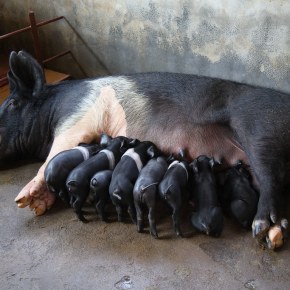
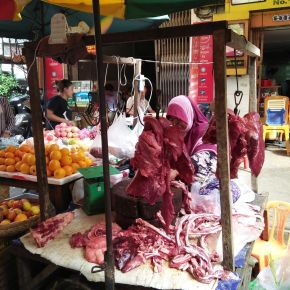
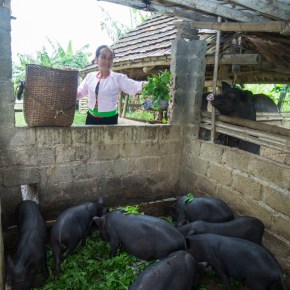
On 26 Nov 2018, the National Institute of Hygiene and Epidemiology (NIHE) of Vietnam and the International Livestock Research Institute (ILRI) signed a memorandum of agreement that will pave way for deepening their collaboration in research for development. Continue reading
Category Archives: Regions
Vietnamese partners further deliberate on setting up a One Health research centre for better policy impacts
A recent meeting of Vietnamese One Health experts further deliberated on the modalities of establishing a national One Health centre that will bring together human and animal health sector experts in the country and advance the translation of One Health research into policy. Continue reading
ILRI research on animal health and food safety featured at 15th symposium of veterinary epidemiology and economics
Findings from animal health and food safety research by scientists from the International Livestock Research Institute (ILRI) and partners were presented at the 15th International Symposium of Veterinary Epidemiology and Economics (ISVEE 15) that was held 12-16 November 2018 in Chiang Mai, Thailand. Continue reading
Transforming livelihoods in South Asia through sustainable livestock research and development
On 13 and 14 November 2018, the International Livestock Research Institute (ILRI) convened a regional workshop with partners from Bangladesh, India, Nepal and Pakistan. Together with ILRI senior staff and scientists, participants from public and private institutions reviewed country development outcomes, agricultural priorities and constraints and potential contributions of the livestock sector in the region. Continue reading
Urgent action needed to close the ‘livestock data gap’ to address poverty and food insecurity
From 28-30 November 2018, the meeting of the Livestock Data for Decisions (LD4D) Community of Practice brings together key people from academia, NGOs, donor agencies and industry to address the challenge of missing or poor data, and develop innovative approaches to inform policies and investments in the livestock sector. Continue reading
CGIAR agriculture for nutrition and health program supports capacity development for food safety in Bangladesh
Scientists from the International Livestock Research Institute (ILRI) and the CGIAR Research Program on Agriculture for Nutrition and Health (A4NH) have trained more than 30 stakeholders working on food safety in Bangladesh on different frameworks for food safety risk assessment that could improve safety of food in the country. Continue reading
One Health: Antibiotic resistance, zoonotic diseases and food security in focus for SIGHT Award 2018
Johanna Lindahl, senior scientist in veterinary-epidemiology, is awarded the SIGHT Award 2018 and SEK 100 000 from the Swedish Institute for Global Health Transformation, SIGHT. The prize is awarded for excellent scientific contribution to global health. Continue reading
Lessons from One Health/EcoHealth in Asia presented at global conference in Italy
At the conference recently held in Bologna, Italy, Hung Nguyen, the International Livestock Research Institute (ILRI) regional representative for East and Southeast Asia, gave a presentation reflecting on the use of One Health and EcoHealth in Asia. Continue reading
Call to improve food safety in low- and middle-income countries—From hazards to risks and from farm to fork
Originally posted on ILRI news:
The Milkmaid, by Johannes Vermeer, 1660. Food safety hazards are increasingly recognized as a major public health problem worldwide, yet among developing countries, there is limited understanding of the wider-ranging socioeconomic costs of unsafe food and the benefits of remedial or preventative measures. This limited evidence base has led many…
New World Bank report says food-borne illnesses cost US$ 110 billion per year in low- and middle-income countries
Originally posted on AgHealth:
Rinsing fresh fish in Accra, Ghana (photo credit: ILRI/Kennedy Bomfeh). A new World Bank study finds that the impact of unsafe food costs low- and middle-income economies about US$ 110 billion in lost productivity and medical expenses each year. Yet a large proportion of these costs could be avoided by adopting…